Criteria for Determining Whether an Overseas Electronic Product Will Work Properly Domestically Based on Voltage, Standards, and Communication Requirements
Understanding the Core Compatibility Factors for Overseas Electronics
An overseas electronic product is worth buying only when the exact model is compatible with your local power supply, essential communication services, and intended use. A different plug does not necessarily make the product incompatible, but a matching plug does not make it safe either.
For use in South Korea, begin with the rating label on the product or its original power supply. Look for the input voltage, frequency, wattage, and exact model number. Then determine whether the product can be used directly, needs only a plug adapter, requires additional equipment, or should be replaced with a Korean-market version.
Do not make the decision from the product name alone. Manufacturers often sell visually identical regional models with different power supplies, cellular bands, firmware, warranties, or included accessories.
Decide First Whether the Product Is Electrically Compatible
South Korean household electricity is generally supplied at approximately 220–230 volts and 60 hertz. The first question is therefore not whether the plug fits, but whether the product’s input rating includes this supply.
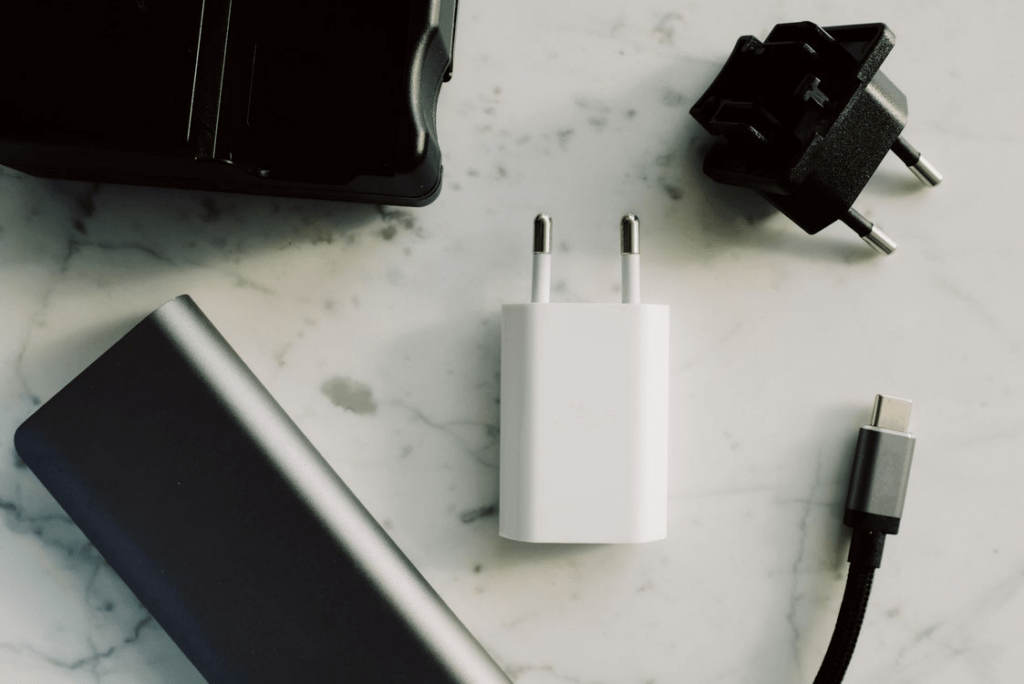
A label such as Input: 100–240 V, 50/60 Hz usually indicates that the power supply can accept both common voltage systems. This is common on laptop chargers, phone chargers, camera adapters and many other products using switching power supplies. In that case, only a correctly rated plug adapter or compatible power cord may be necessary.
A product labeled only 100 V, 110 V or 120 V must not be connected directly to a Korean outlet. A plug adapter changes only the shape of the connection. It does not reduce the voltage. Connecting a 120 V appliance directly to a supply near 220–230 V can damage the product and create an electrical or fire hazard.
The frequency must also be checked separately. A label that accepts 220–240 V but specifies only 50 Hz is not automatically suitable for South Korea’s 60 Hz supply. Frequency is less likely to matter for a modern electronic power adapter marked 50/60 Hz, but it can affect products containing AC motors, pumps, compressors, transformers, mechanical timers or speed-dependent components.
This distinction is especially important for:
| Product type | Recommended decision |
|---|---|
| Phone, laptop or camera charger marked 100–240 V, 50/60 Hz | Usually usable with a suitable plug adapter or power cord |
| Appliance marked only 100–120 V | Do not plug in directly; investigate a transformer or choose a local model |
| Hair dryer, heater, kettle or cooking appliance from a 120 V market | A domestic version is usually more practical than operating it through a large transformer |
| Fan, turntable, clock, pump or appliance with an AC motor | Confirm 60 Hz support with the manufacturer |
| Refrigerator, air conditioner or washing machine | Prefer a Korean-market model unless the manufacturer explicitly supports Korean power conditions |
A transformer is not automatically a good solution. It must support the required input and output voltages, the appliance’s operating wattage and any higher startup demand from a motor or compressor. It also adds heat, weight, noise and another possible point of failure.
For a low-power device used occasionally, a properly selected transformer may be acceptable. For a continuously operating or high-wattage appliance, buying the domestic version is usually safer and simpler.
Check Whether the Main Features Will Work in Korea
Passing the power test does not mean the product will provide its full functionality. Connected electronics may depend on radio frequencies, regional firmware, mobile applications, cloud services and local network support.
For a smartphone or cellular tablet, compare the exact model number—not just the commercial name—with the requirements of the Korean carrier you intend to use. Confirm support for the necessary LTE and 5G bands, but also check VoLTE, eSIM, carrier activation, tethering and Wi-Fi calling. A phone can connect to mobile data while still losing calling features, indoor coverage or carrier-specific services.
Wi-Fi devices require a similar check. Channel availability and transmission rules can differ by region, particularly in parts of the 5 GHz and 6 GHz spectrum. A foreign router, smart camera or home-automation hub may have firmware configured for its original market. It may connect normally, expose only part of its channel range, or fail to complete setup after detecting a different region.
The companion application can be just as important as the hardware. Before importing a smart speaker, robot vacuum, security camera or connected appliance, verify:
- Whether the app is available in the Korean app stores.
- Whether a Korean phone number or local account is required.
- Whether the device allows its country or server region to be changed.
- Whether voice assistants and subscription features operate in Korea.
- Whether cloud storage, payment or remote access is region-restricted.
- Whether Korean-language support is important for daily use.
Game consoles, televisions and media devices may introduce additional restrictions involving account regions, digital stores, broadcast tuners, streaming applications or content formats. Even when the hardware powers on, the feature that justified the purchase may be unavailable.
Wireless and communications equipment can also be subject to Korean conformity-assessment requirements. The applicable procedure depends on the product category and how it is imported or distributed. A seller’s statement that a product “works worldwide” should not replace a model search in the relevant Korean certification database or confirmation from the manufacturer.
Choose Between Direct Use, Modification and a Domestic Version
After checking the specifications, place the product into one of four outcomes.
Use it with only a plug adapter or replacement cable
This is the appropriate result when the label supports approximately 220–230 V and 60 Hz, the required network features work in Korea, and no essential service is locked to another region.
This outcome is common for universal laptop chargers, USB-C power adapters, cameras and small electronics with detachable power supplies. Use an adapter and cable rated for the device’s current and power requirements rather than the cheapest available travel adapter.
Use it only after replacing the external power supply
Some products operate internally on low-voltage DC and receive power through an external adapter. When the original adapter is unsuitable, it may be possible to replace it with a Korean-compatible unit.
The replacement must match all relevant specifications:
- Output voltage.
- Minimum current or wattage.
- AC or DC output type.
- Connector dimensions.
- Connector polarity.
- Any proprietary charging or communication protocol.
Matching the plug alone is not sufficient. An adapter with the wrong output voltage or polarity can damage the product.
Buy only after manufacturer confirmation
Pause the purchase when compatibility depends on a 50/60 Hz motor, cellular functions, regional firmware, a cloud service or a proprietary accessory. Ask the manufacturer about the exact model and describe that it will be used in South Korea on a 60 Hz supply.
Do not rely only on marketplace answers such as “an adapter is included” or “customers use it overseas.” Those statements may refer only to the plug shape rather than electrical and service compatibility.
Choose the Korean-market version instead
A domestic version is normally the better choice when the product:
- Draws substantial power.
- Runs continuously.
- Contains a compressor, heater or large motor.
- Requires installation by a technician.
- Depends on Korean cellular or broadcast services.
- Needs regular servicing or consumable parts.
- Is expensive to return internationally.
- Performs a safety-critical or medical function.
The import price should be compared with the complete ownership cost, including the transformer, replacement power supply, customs charges, return shipping, missing accessories and possible loss of local warranty service.
Before paying, obtain a clear answer to five questions: Does the label support Korean voltage and 60 Hz? Will every essential connected feature operate in Korea? Is the exact model permitted and practical to use locally? Can it be repaired or returned? Is the total saving still worthwhile after all required equipment and risk are included?
When any answer remains uncertain, do not test compatibility by plugging the product in. Confirm the specification with the manufacturer or select the domestic model.